


HWD Testing for Airport Pavements
Heavy Weight Deflectometer Testing
QRoad provides specialist Heavy Weight Deflectometer (HWD) testing for airport pavements worldwide. Using calibrated Dynatest equipment, we apply controlled dynamic loads representative of aircraft wheel loading and measure the resulting deflection basin. This non-destructive survey provides reliable data on structural capacity, pavement layer stiffness and subgrade response for flexible and rigid pavements.
HWD testing can be carried out on runways, taxiways, aprons, aircraft stands and other heavily loaded pavement areas. The results help airport pavement managers identify structurally weak areas, evaluate rehabilitation options, estimate remaining structural life and support Pavement Classification Rating (PCR) assessments.
When should airports use HWD testing?
Airport operators and pavement engineers use HWD surveys when planning rehabilitation or overlays, investigating suspected weak areas, evaluating changes in aircraft fleet or traffic demand, and updating pavement-strength information. On rigid pavements, targeted testing can also assess slab support and load-transfer efficiency across joints.
Before mobilisation, QRoad reviews available pavement-construction records, aircraft traffic information and airport operating constraints. This allows the test grid and load sequence to focus on critical pavement areas and make efficient use of available closure windows.
For a complete airport pavement assessment, QRoad can combine HWD measurements with GPR surveys, pavement coring and engineering analysis. Fieldwork can be coordinated around airside operational windows to minimise disruption.
Project example: HWD testing at Muscat International Airport, Oman.

How HWD Testing Works
At each test location, the HWD applies a controlled load pulse to the pavement surface. Geophones positioned at defined distances record the deflection basin. The load level, test spacing and measurement sequence are selected for the pavement type, aircraft loading and assessment objective.
The data can be used to backcalculate pavement layer stiffness, assess load-transfer efficiency at joints, identify structural variability and estimate remaining structural life.
What airport pavement managers receive
- Validated deflection data and quality-control summaries
- Backcalculated pavement layer moduli and subgrade response
- Joint load-transfer results for rigid concrete pavements
- Profiles, maps and geographically referenced datasets
- Structural-capacity and remaining-life assessments to support maintenance, rehabilitation and PCR reporting
The testing is non-destructive and automated, allowing efficient surveys with limited closures when coordinated with airport operations.
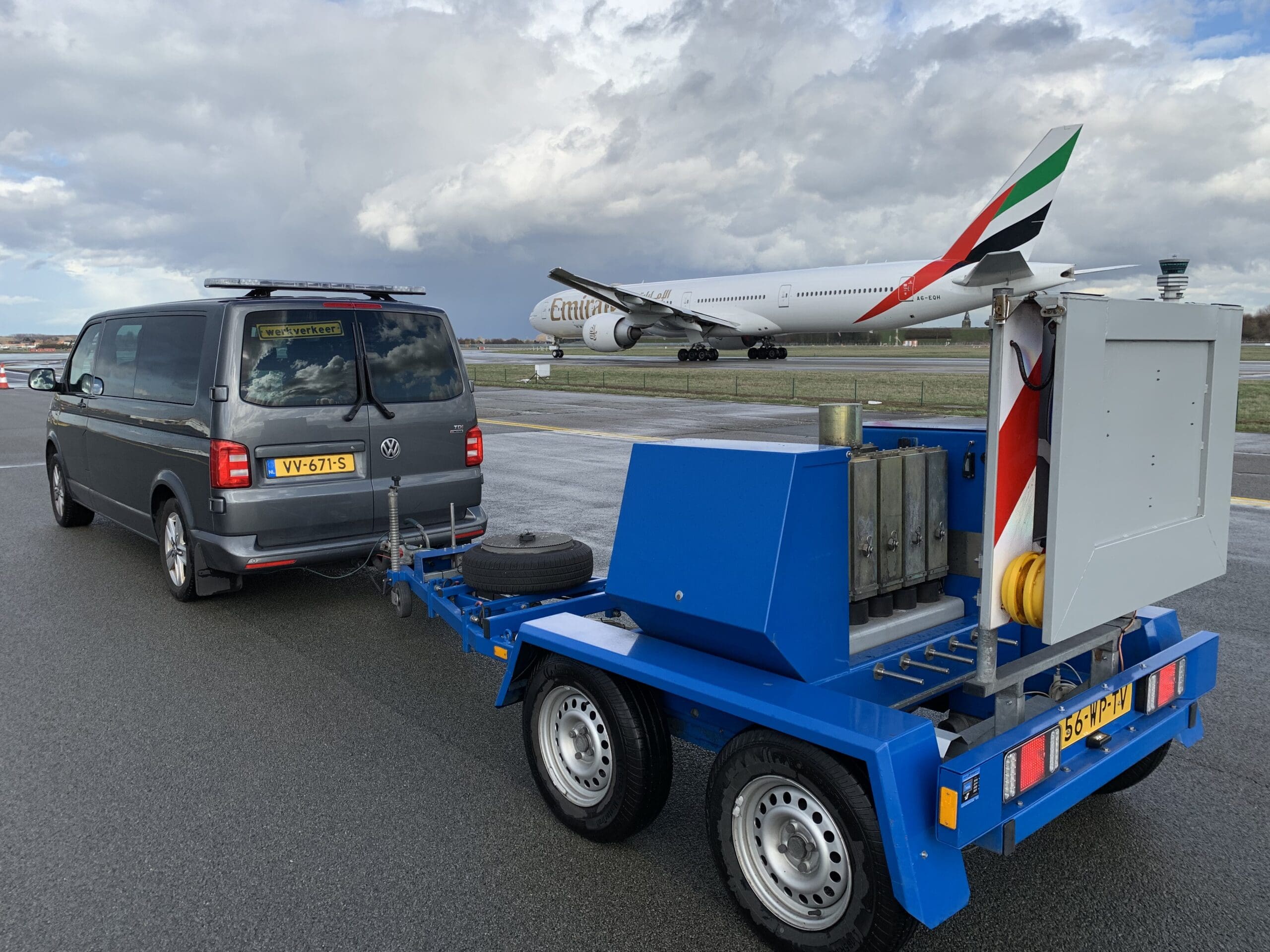
Modern HWD Equipment, Reliable Results
QRoad uses calibrated Dynatest HWD equipment capable of applying loads from 25 to 320 kN. Experienced operators monitor data quality during testing, while QRoad specialists process and interpret the measurements using dedicated pavement-analysis software.
Our equipment and specialists are available worldwide, 24/7 and year-round for airport, port and other heavy-duty pavement projects. Survey plans, test spacing and load sequences are agreed with the client and coordinated with local airside safety requirements.
Frequently asked questions about airport HWD testing
Is HWD testing non-destructive?
Yes. The equipment applies a controlled dynamic load to the pavement surface and records the resulting deflections without cutting or damaging the pavement.
Can HWD surveys be completed without long runway closures?
Testing can normally be divided into efficient operational windows and coordinated with air traffic and airside teams to minimise closures and disruption.
Which airport pavements can be tested?
HWD surveys can assess flexible asphalt pavements and rigid concrete pavements on runways, taxiways, aprons, aircraft stands and other heavily loaded areas.
Can HWD measurements support PCR assessments?
Yes. HWD results provide important structural inputs for PCR assessments when combined with pavement construction information, subgrade conditions and the airport’s representative aircraft fleet and traffic demand.

Key HWD Testing Capabilities for Airport Pavements
- HWD data to support Pavement Classification Rating (PCR) assessments
- Load Transfer Efficiency (LTE) testing at concrete pavement joints
- Testing of flexible and rigid airport pavements
- Wide dynamic load range: 25–320 kN
- Factory-calibrated and CROW-certified Dynatest HWD equipment
- Worldwide airport pavement testing with experienced specialists